AI-generated content is everywhere – blogs, emails, student essays, even business reports. But figuring out what’s written by AI (and what’s human) is getting harder every day. If you’re relying on a single tool or gut feeling, you’re likely making mistakes.
In this guide, you’ll learn how to detect AI-generated content more reliably using a practical, step-by-step approach that combines tools, manual analysis, and real-world testing. No hype – just what actually works.
Why AI Content Detection Is So Difficult
Before jumping into methods, it’s important to understand the core problem.
AI writing tools today are trained on massive datasets. They mimic human tone, structure, and even subtle writing patterns. That means:
- AI can sound natural
- Humans can sound “AI-like” (especially formal writing)
- Edited AI content becomes even harder to detect
👉 This is why AI detection accuracy is never 100%. Even the best tools can produce false positives and false negatives.
Try It Yourself – Detect AI Content Instantly
The fastest way to start is by testing content yourself.
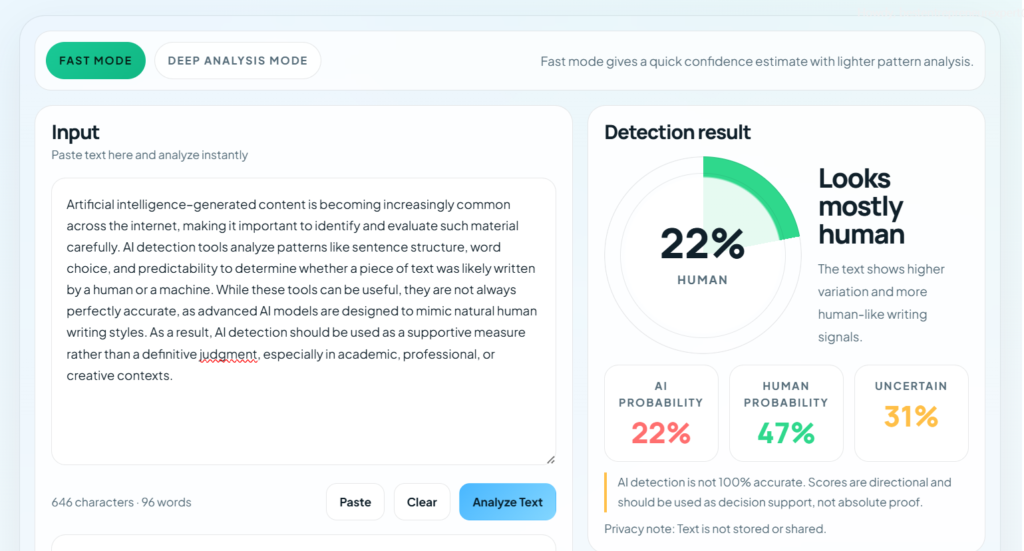
Use PasteReady AI Detector (Step-by-Step)
- Copy the content you want to analyze
- Paste it into the detector
- Run the scan
- Review the AI probability score and highlighted sections
👉 Use the tool here:
What to Look for in the Results
- AI Score (e.g., 70%) → Indicates likelihood, not certainty
- Highlighted sections → Parts that appear AI-generated
- Consistency → Does the whole text feel the same tone?
💡 Important: Never rely on just one result. Use this as your starting point.
How AI Detection Tools Actually Work
Understanding the basics helps you interpret results better.
1. Predictability (Perplexity)
AI tends to generate more predictable text. Tools measure how “expected” the wording is.
- Low variation → likely AI
- High variation → more human
2. Sentence Variation (Burstiness)
Humans write with natural variation:
- Short + long sentences
- Mixed structure
AI often produces:
- Even sentence length
- Consistent structure
3. Pattern Recognition
AI detectors use machine learning models trained on:
- Human-written text
- AI-generated text
They look for patterns that distinguish the two.
Why AI Detectors Are Not Fully Reliable
Let’s be clear: no AI detector is perfect.
Common Problems
1. False Positives
Human content gets flagged as AI
(Common in academic or formal writing)
2. False Negatives
AI content passes as human
(Common after editing or paraphrasing)
3. Short Text Issues
Small samples = unreliable results
According to research discussed by MIT Technology Review, detection tools still struggle to consistently distinguish between advanced AI and human writing, especially when content is edited.
👉 External reference: https://www.technologyreview.com/
Step-by-Step: Detect AI-Generated Content More Reliably
This is where most guides fail — they explain tools, but not how to actually use them together.
Follow this process:
Step 1: Use Multiple AI Detection Tools
Never rely on one tool.
👉 Combine:
- PasteReady AI Detector → [Internal Tool Link]
- AI Content Checker → [Internal Tool Link]
- Plagiarism Checker → [Internal Tool Link]
If 2–3 tools show similar results, confidence increases.
Step 2: Analyze Writing Style Manually
Look for:
- Repetitive sentence structures
- Overly polished tone
- Lack of personal voice
- Generic phrases
AI often sounds “perfect” — but lacks depth.
Step 3: Check for Context Gaps
AI tends to:
- Stay general
- Avoid strong opinions
- Miss real-world detail
Ask:
👉 Does this content feel experienced or just assembled?
Step 4: Verify Facts and Specificity
AI sometimes:
- Hallucinates facts
- Uses vague statements
Cross-check:
- Dates
- Names
- Data
Step 5: Combine All Signals
Here’s a simple framework:
- High AI score + weak writing → likely AI
- Mixed scores + strong voice → uncertain
- Low score + human tone → likely human
💡 This combination approach is what improves reliability.
Manual Techniques to Detect AI Writing
Even without tools, you can spot patterns.
Linguistic Clues
- Repetitive phrasing
- Balanced sentence lengths
- Predictable structure
Tone Indicators
- Too neutral
- No emotion
- No personal experience
Structural Patterns
- Clean but generic paragraphs
- No storytelling
- No unique perspective
👉 Learn more: [Internal Blog Link – “Manual AI Detection Techniques”]
Best AI Detection Tools Compared
| Tool | Strength | Best Use |
|---|---|---|
| PasteReady | Easy + fast results + Free | General detection |
| Grammarly | Detailed analysis | Academic content |
| Quilbot | Multi-format support | PDFs & documents |
👉 Start here:
Detecting AI Content Across Different Formats
Blogs & Articles
- Check tone + structure
- Look for repetition
Academic Essays
- High false positive risk
- Use multiple tools
PDFs & Documents
- Convert to text first
- Then analyze
Social Media Content
- Harder to detect
- Focus on tone & style
Common Mistakes to Avoid
- ❌ Using only one tool
- ❌ Trusting scores blindly
- ❌ Ignoring manual review
- ❌ Assuming 100% accuracy
👉 Remember: AI detection is about probability, not certainty.
Real Example – AI vs Human Content
Let’s break it down:
AI Content:
- Clean structure
- Generic wording
- No personality
Human Content:
- Natural variation
- Personal tone
- Imperfections
Final Verdict: What Makes Detection More Reliable
To truly detect AI-generated content more reliably, you need:
- ✔ Multiple tools
- ✔ Manual analysis
- ✔ Context understanding
- ✔ Fact-checking
Not just one method — but a system.
Frequently Asked Questions
How can you tell if content is AI-generated?
Use a mix of AI detection tools and manual analysis. Look for patterns, tone, and consistency.
Are AI detectors reliable?
They are helpful but not fully accurate. Always combine multiple tools and human review.
What is the most accurate AI detection method?
A multi-step approach: tools + manual review + fact-checking.
Can AI-generated content pass detection tools?
Yes. Especially if it’s edited or paraphrased.
How do you manually detect AI writing?
Look for repetitive structure, generic tone, and lack of real-world detail.
Is AI detection better than plagiarism detection?
They serve different purposes. AI detection identifies writing origin, while plagiarism checks duplication.
Final Thought
AI content detection is evolving — and so should your approach. If you rely on just one method, you’ll get inconsistent results. But if you combine tools like PasteReady with manual analysis, you’ll make far more reliable decisions.
👉 Start testing now: →
NOTE: “For best results, combine this tool with manual review.”